Healthcare & Life Sciences

Your Healthcare IT Systems Are Unique.
Opkey Manages Them That Way.

From CDM updates and 340B compliance to credentialing workflows and CMS survey readiness — Opkey manages your entire cloud application lifecycle so your team can focus on patient care, not system firefighting.

Trusted by world-class enterprises

Sound Familiar?

The Challenges Only Healthcare Teams Understand

These aren't hypothetical — they surface during implementations, day-to-day operations, vendor updates, regulatory changes, and staff transitions across every phase of your application lifecycle.
CDM

Your Charge Description Master Updates Are Breaking Revenue

Every CDM update touches thousands of charge codes. One wrong mapping between a CPT code and a revenue code means denied claims, delayed reimbursement, and compliance exposure — and your revenue integrity team finds it weeks later during reconciliation.

Credentialing

Provider Credentialing Workflows Fail Silently

A provider's credentials expire. The workflow that should block scheduling doesn't fire because a patch changed how the rule evaluates. Patients get scheduled with non-credentialed providers. You find out when the payer denies the claim — or worse, during a Joint Commission audit.

340B

340B Drug Pricing Compliance Is a Configuration Minefield

340B split-billing configurations determine whether you buy at the 340B ceiling price or WAC. One misconfigured pharmacy, one wrong patient eligibility rule, and you're either overpaying by hundreds of thousands or facing HRSA audit findings and potential program exclusion.

 
Cures Act

Interoperability Mandates Require Constant API Validation

The 21st Century Cures Act requires open APIs for patient access. Every ERP and clinical system update can break FHIR endpoints, patient matching logic, and data exchange workflows — and ONC enforcement is only getting stricter.

CMS CoP

CMS Conditions of Participation Demand Validated Systems

Your Medicare/Medicaid participation depends on validated, functioning systems. When CMS surveys, they test whether your systems actually work — not whether you have documentation. A single system failure during a survey can trigger an Immediate Jeopardy finding.

 
20%+

Clinical Staff Turnover Compounds System Risk

annual turnover in healthcare. Revenue cycle analysts, supply chain specialists, and clinical informaticists leave with knowledge of how your systems are actually configured — knowledge that never made it into any documentation.

CDM

Your Charge Description Master Updates Are Breaking Revenue

Every CDM update touches thousands of charge codes. One wrong mapping between a CPT code and a revenue code means denied claims, delayed reimbursement, and compliance exposure — and your revenue integrity team finds it weeks later during reconciliation.

Credentialing

Provider Credentialing Workflows Fail Silently

A provider's credentials expire. The workflow that should block scheduling doesn't fire because a patch changed how the rule evaluates. Patients get scheduled with non-credentialed providers. You find out when the payer denies the claim — or worse, during a Joint Commission audit.

340B

340B Drug Pricing Compliance Is a Configuration Minefield

340B split-billing configurations determine whether you buy at the 340B ceiling price or WAC. One misconfigured pharmacy, one wrong patient eligibility rule, and you're either overpaying by hundreds of thousands or facing HRSA audit findings and potential program exclusion.

 
Cures Act

Interoperability Mandates Require Constant API Validation

The 21st Century Cures Act requires open APIs for patient access. Every ERP and clinical system update can break FHIR endpoints, patient matching logic, and data exchange workflows — and ONC enforcement is only getting stricter.

CMS CoP

CMS Conditions of Participation Demand Validated Systems

Your Medicare/Medicaid participation depends on validated, functioning systems. When CMS surveys, they test whether your systems actually work — not whether you have documentation. A single system failure during a survey can trigger an Immediate Jeopardy finding.

 
20%+

Clinical Staff Turnover Compounds System Risk

annual turnover in healthcare. Revenue cycle analysts, supply chain specialists, and clinical informaticists leave with knowledge of how your systems are actually configured — knowledge that never made it into any documentation.

Managing Healthcare Cloud Applications Requires Full Lifecycle Intelligence

It's not just about surviving the next vendor update. Your healthcare cloud applications need lifecycle management — from initial go-live and system design through daily clinical operations, regulatory mandate changes, CDM restructuring, and continuous survey readiness.

Generic tools don't understand healthcare lifecycles. They can't distinguish a benign CDM change from one that generates thousands of claim denials. They don't know that onboarding a new provider requires validating credentialing, scheduling, and billing workflows end-to-end. They miss the compliance implications when staff turnover breaks institutional knowledge.
How Opkey Works

AI Agents That Understand Healthcare Operations

Not generic automation — purpose-built AI Agents trained on the processes, configurations, and compliance requirements unique to healthcare organizations.

Design & Discovery

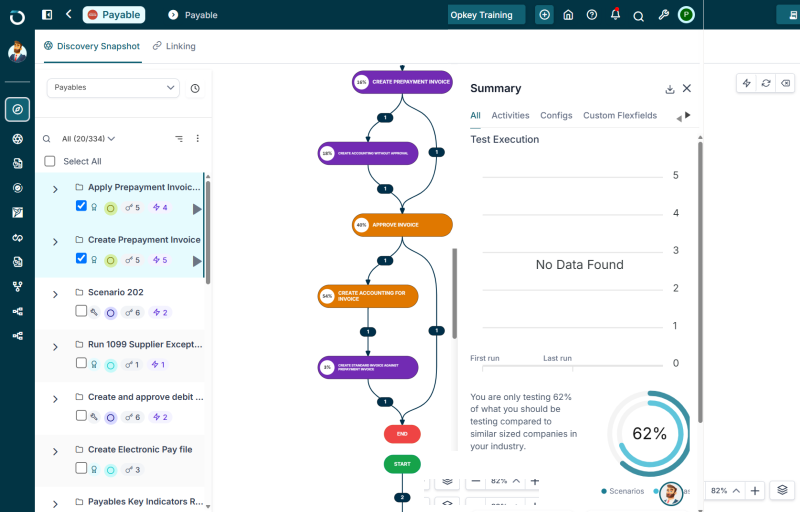
Opkey maps every operational workflow — charge capture, claims adjudication, provider credentialing, 340B split-billing, supply chain, and clinical documentation — and identifies the exact process paths that break when your cloud applications update.
100%
Process Visibility

Intelligent Configuration

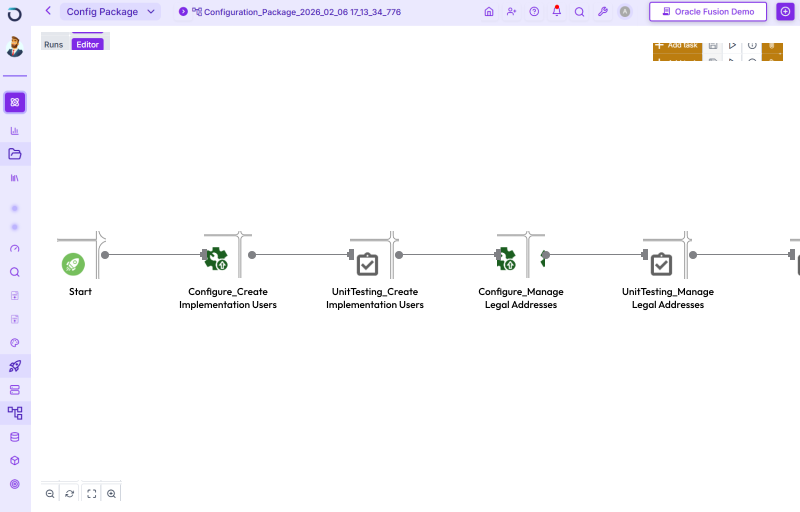
Continuously monitor CDM mappings, credentialing rules, 340B pharmacy configurations, HIPAA access controls, and billing determinants across all environments. When a patch changes how a rule evaluates, Opkey catches the drift before it reaches production.
Zero
Config Drift

Test Automation

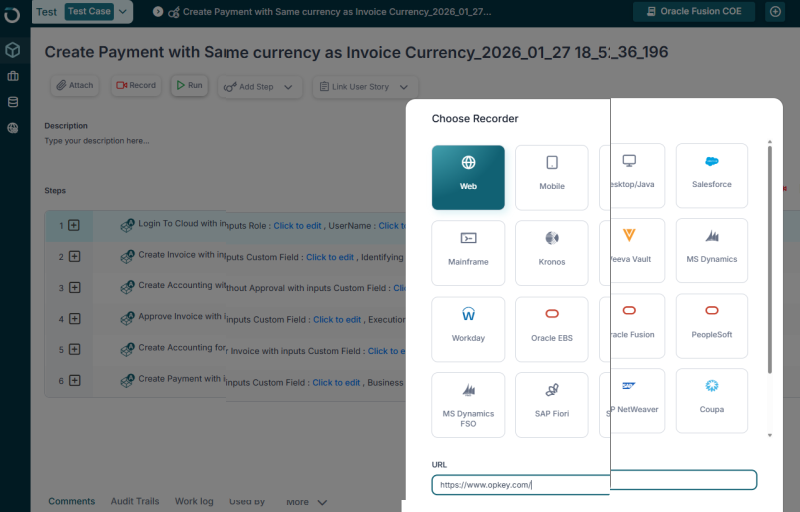
Pre-built test cases for revenue cycle, credentialing, 340B compliance, supply chain, and clinical workflows. When Oracle, Workday, or Infor pushes an update, Opkey validates that your charge capture, claims processing, and compliance rules still work — automatically.
90%
Risk Reduction

Training & Adoption

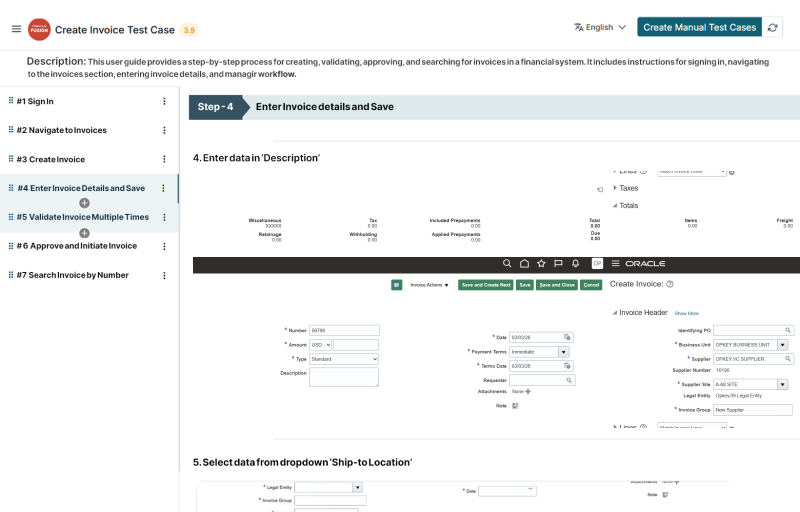
Auto-generate role-specific training for revenue cycle staff, supply chain managers, credentialing coordinators, and clinical informaticists. When configurations change, guides update automatically — critical in an industry with 20%+ turnover.
60%
Fewer Tickets

Change Management

Every update, every configuration change — automatically assessed for impact on CMS Conditions of Participation, 340B compliance, credentialing workflows, and revenue integrity. Complete documentation generated for Joint Commission and CMS surveys.
100%
Survey Ready
Argus AI Engine

An AI Trained on Healthcare Data

Argus doesn't approximate what a CDM mapping should look like. It doesn't guess how 340B eligibility rules work. It knows — because it's trained on actual healthcare configurations, workflows, and compliance frameworks.

Revenue Cycle & CDM Management

Trained on charge description master structures, CPT/ICD-10 mapping rules, payer contract configurations, denial management workflows, and revenue integrity patterns across major health systems.

340B & Drug Pricing Compliance

Deep understanding of split-billing configurations, contract pharmacy arrangements, patient eligibility determination, accumulator logic, and HRSA audit requirements for 340B covered entities.

Provider Credentialing & Privileging

Credentialing workflow rules, privilege delineation, reappointment cycles, OPPE/FPPE trigger configurations, and payer enrollment processes specific to healthcare organizations.


Interoperability & FHIR APIs

Patient matching algorithms, FHIR R4 endpoint configurations, CCD-A document generation, ADT event processing, and 21st Century Cures Act compliance requirements.

Clinical Supply Chain

OR preference card configurations, implant tracking workflows, formulary management rules, par level calculations, and clinical inventory management patterns specific to healthcare.


CMS & Joint Commission Readiness

Conditions of Participation system requirements, survey readiness checklists, system validation evidence frameworks, and regulatory reporting configurations for Medicare/Medicaid compliance.

Revenue Cycle & CDM Management

Trained on charge description master structures, CPT/ICD-10 mapping rules, payer contract configurations, denial management workflows, and revenue integrity patterns across major health systems.

340B & Drug Pricing Compliance

Deep understanding of split-billing configurations, contract pharmacy arrangements, patient eligibility determination, accumulator logic, and HRSA audit requirements for 340B covered entities.

Provider Credentialing & Privileging

Credentialing workflow rules, privilege delineation, reappointment cycles, OPPE/FPPE trigger configurations, and payer enrollment processes specific to healthcare organizations.


Interoperability & FHIR APIs

Patient matching algorithms, FHIR R4 endpoint configurations, CCD-A document generation, ADT event processing, and 21st Century Cures Act compliance requirements.

Clinical Supply Chain

OR preference card configurations, implant tracking workflows, formulary management rules, par level calculations, and clinical inventory management patterns specific to healthcare.


CMS & Joint Commission Readiness

Conditions of Participation system requirements, survey readiness checklists, system validation evidence frameworks, and regulatory reporting configurations for Medicare/Medicaid compliance.

Integration Ecosystem?

Healthcare Runs on Dozens of Connected Systems

Your ERP doesn't operate in a vacuum. It's the financial backbone connected to clinical, operational, and compliance systems — each with its own update cycle, API contracts, and data formats.

Epic / Cerner EHR

Patient demographics, encounter data, and charge capture flow from EHR to ERP. One changed HL7 segment = revenue cycle disruption.

PACS & Imaging Systems

Radiology orders, imaging results, and billing data flow between PACS and your ERP. Broken interfaces mean unbilled procedures.

Pharmacy Systems (Pyxis, Omnicell)

Drug dispense data, 340B split-billing decisions, and inventory replenishment all integrate with your ERP. One mapping error = compliance exposure.

Lab Information Systems

Lab orders, results, and billing codes flow from LIS to EHR to ERP. A changed interface means lab charges don't post — and revenue leaks.

Claims Clearinghouses (Availity, Change)

837/835 transactions flow between your ERP and clearinghouses. Changed EDI formats = rejected claims and delayed reimbursement.

Medical Device Integration

IoMT devices feed patient data, utilization metrics, and supply consumption into your systems. Broken feeds = missing charge capture.

Health Information Exchanges

ADT notifications, CCD-A documents, and care summaries flow through HIEs. Integration failures = gaps in care coordination and compliance.

Revenue Cycle Platforms (Waystar, R1)

Denials management, prior auth, and payment posting all integrate with your ERP. One broken API = denial backlogs and cash flow gaps.
How Opkey Handles This
Opkey validates the complete data flow — from Epic charge capture through your ERP's revenue cycle to the clearinghouse 837 submission. When Oracle or Workday pushes an update, Opkey traces the impact across every integration: Are HL7 messages still parsing? Is 340B split-billing still routing correctly? Are lab charges still posting to the right revenue codes?
HL7/FHIR Validation
EDI 837/835 Testing
End-to-End Revenue Cycle
Cross-System Regression
Real-World Outcomes

What Changes When You Deploy Opkey

These aren't features — they're the outcomes your healthcare teams experience.
$1M+
Revenue protected
Protect Revenue After Every CDM Update
When your CDM changes — new CPT codes, updated charge mappings, revised payer rules — Opkey validates every charge code, every revenue code mapping, and every billing determinant. Your revenue integrity team stops finding errors in month-end reconciliation.
100%
340B compliant
Stay 340B Compliant Without the Manual Audits
Opkey continuously validates 340B split-billing configurations, patient eligibility rules, and contract pharmacy setups. When system updates change how eligibility evaluates, Opkey catches the change before it leads to HRSA findings.
Zero
Survey findings
Pass CMS Surveys With System Confidence
CMS surveyors test whether your systems work — not just whether you documented them. Opkey continuously validates credentialing workflows, access controls, and clinical processes, generating the evidence surveyors expect to see.
FAQ

Frequently Asked Questions

Everything you need to know about Opkey for Healthcare.

Still have questions?

Talk to an expert about your Healthcare challenges.

Talk to an expert →

Opkey validates every charge code mapping, CPT/ICD-10 relationship, revenue code assignment, and billing determinant. When CDM updates happen or payer contracts change, Opkey runs the full validation automatically — catching revenue leakage before it reaches claims.

Yes. Opkey tests 340B pharmacy configurations, patient eligibility rules, accumulator logic, and contract pharmacy setups. When system updates change how eligibility or split-billing evaluates, Opkey detects the change and validates compliance before the next dispense.

Opkey continuously validates the system controls that CMS surveys test — credentialing workflows, access controls, clinical documentation processes, and billing accuracy. Validation evidence is generated automatically, so you're always survey-ready.

Yes. Opkey validates FHIR endpoints, patient matching logic, ADT event processing, and data exchange workflows required by the 21st Century Cures Act. When your EHR or ERP updates, Opkey ensures interoperability mandates are still met.

Argus isn't a generic AI running financial prompts. It's trained on actual healthcare operations — CDM structures, 340B configurations, credentialing workflows, CMS requirements, and revenue cycle patterns from hundreds of healthcare organizations. It understands the difference between a charge code mapping error and a benign configuration change.

Most organizations see impact within the first update cycle — reduced CDM-related claim denials, automated 340B compliance validation, and continuous survey readiness. Measurable results within 30-60 days.

Ready to See What Opkey Can Do for Your Industry?

Talk to an expert who understands your specific cloud application challenges.
© 2026 Opkey. All rights reserved.
×